AI Marketing Analytics and Automation for Smarter Ad Spend.
Marketing Copilot is governed AI that automates your marketing workflows, from trusted answers and marketing mix modelling to value signals and a monthly report that builds itself.
Video transcript
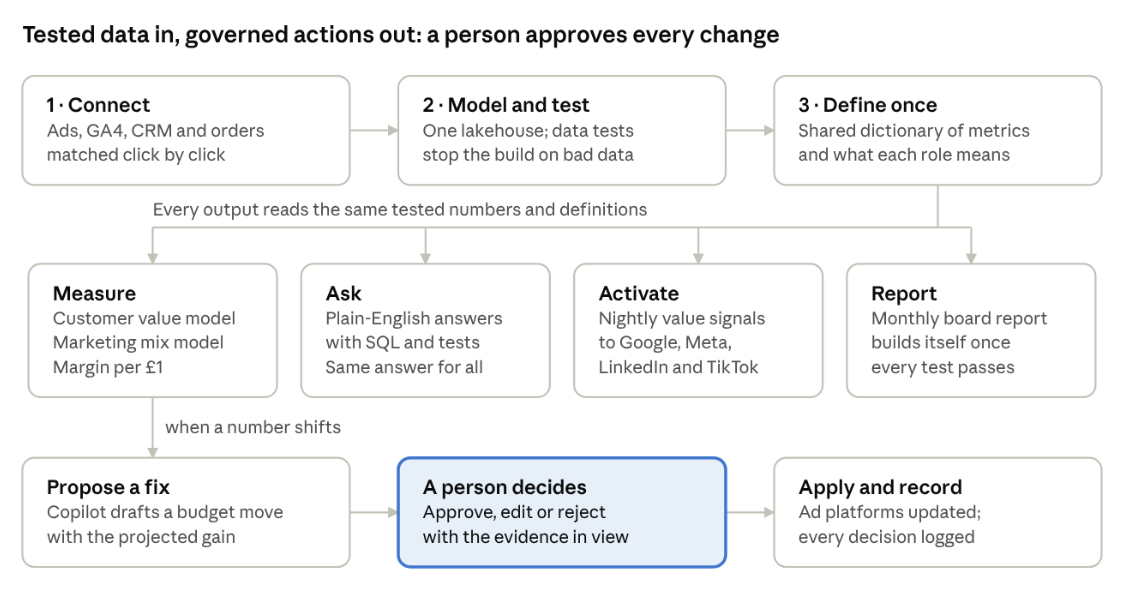
A 2024 Gartner survey found that only 52 percent of senior marketing leaders can prove marketing's value and get credit for it. Meet Marketing Copilot by aQb Solutions. Governed AI that joins ad spend, website visits, orders and CRM leads into one tested source of truth. Connect your ad platforms once, and every click is matched to a real order. Tell it who is asking. Each role sets what recently means, and who can approve spend. Then anyone can ask in plain English. Every answer shows its definition, its SQL and the data tests behind it. Every metric is defined once, so marketing and finance get the same answer. Campaigns are ranked by what their customers are worth over twelve months, not by the platform's cost per sale. Marketing mix modelling shows what each channel really adds, and where extra spend stops paying back. The monthly board report builds itself from the same tested numbers. Every night it tells Google, Meta, LinkedIn and TikTok what each new customer is worth, so bidding chases value, not volume. When performance shifts, it proposes a budget move. Here, Meta's cost per customer has nearly doubled, so it suggests moving budget into Google search. Each proposal shows the projected gain and the evidence, and you can edit the amount before you approve. Nothing changes in any ad platform until a person approves, and every decision is logged. Shown on synthetic data for a fictional retailer. Spend smarter. Report faster. Stay in control.
Impact you can measure
Illustrative targets, to be confirmed in a pilot on your own data.
Days → MinutesTarget time to answer an ad hoc performance question
Days → 1-2 hrsTarget time to produce the monthly marketing report
Weeks → DaysTarget time to spot a cost spike and propose a fix
Volume → ValueTarget: ad platforms bid for customer value, not sale count
Many → 1Target versions of each key metric across teams and tools
100%Target: every budget change approved by a person and logged
What it does
Answers from one shared dictionary
Ask in plain English and get one number, a chart and a short explanation, with the definition, SQL and data tests behind it. Every metric is defined once, so the head of marketing and the finance director get the same answer.
Customers worth having
A predictive model estimates what each new customer will earn over 12 months. Campaigns are ranked by margin per £1, next to what the ad platform claims they cost.
Marketing mix modelling
Separates the effect of ads from seasonality and organic demand, so you see what each channel really adds. Response curves show where extra spend stops paying back.
Value signals to ad platforms
Every night, Google, Meta, LinkedIn and TikTok learn what each new customer and trade lead is worth. Automated bidding then chases valuable customers, not cheap ones.
A monthly report that builds itself
The board report is generated from the same verified numbers, only after every data test passes. No copying numbers into slides.
Recommended actions, with people in control
When a campaign's cost jumps, the copilot proposes a budget move with the projected gain and the evidence. A person approves, edits or rejects it, and every decision is logged.
Key Questions Answered
01 / 04
What can it analyse?
Paid media on Google Ads, Meta, TikTok and LinkedIn, website visits from GA4, orders and margin from your shop or ERP, and leads from your CRM. Marketing mix modelling covers channels with weekly spend; sales that close weeks after the click, such as B2B deals, are valued from CRM leads instead. Metrics outside the shared dictionary are out of scope until they are defined.
02 / 04
What inputs are required?
Read-only access to your ad accounts and GA4, an order or ERP export with margin, and CRM leads with their click IDs. About two years of weekly history for marketing mix modelling. A short workshop agrees each metric's definition and what each role means by words like "recently".
03 / 04
What does it produce, and what needs review?
Answers with the definition, SQL and data tests behind them, a campaign ranking by predicted customer value, a marketing mix model with response curves, nightly value signals and a monthly report. Budget changes are recommendations: a person approves, edits or rejects each one, and nothing reaches an ad platform before that.
04 / 04
What has been validated?
The film uses synthetic data for a fictional retailer. On that data, the marketing mix model was checked on 12 weeks it never saw, with a 1.7% forecast error, and the customer value model on held-out customers. Results on real accounts are measured in a pilot on your own data, and no measured client results are published on this page yet.
How it works
01Connect Channels
02Load and Test Data
03Define Metrics Once
04Ask and Measure
05Send Value Signals
06Propose and Approve
07Report and Log
Technology stack
Amazon ECS
Amazon S3
AWS Glue
Amazon SageMaker
Amazon Bedrock
AWS Lambda
React
FastAPI
Use cases
01Budget that follows valuable customers
01Online retail and D2C
Budget that follows valuable customers
Rank every campaign by what its customers will earn over 12 months, not by the platform's cost per sale, and move budget with a person approving each change.
02Leads worth chasing
02B2B and trade sales
Leads worth chasing
Score each lead by its chance to close and its likely value, and send that value back to Google, LinkedIn and Meta every night so bidding favours leads that win.
03One number for the board
03Marketing and finance leadership
One number for the board
Agree every metric once, measure what each channel really adds, and get a monthly report that builds itself from tested data.